Alicia Brooks Design

Work
About
IBM AI-Powered
Executive Tool

Case study
Introduction
At IBM, blogging is done through a platform called Publisher — the company’s global website builder used by over 500,000 IBMers to create and manage digital content, including blogs, product pages, and landing experiences. Publisher powers thousands of IBM sites and is a foundational tool within the company’s digital ecosystem.
While Publisher is robust, executive users faced unique challenges: their content often required faster turnarounds, strategic framing, and support from multiple stakeholders. Many executives struggled to draft or publish blogs efficiently, relying heavily on internal teams for writing, editing, and approvals. This led to missed opportunities to share timely thought leadership and created bottlenecks across communications workflows.
As the Lead Product Designer, I was tasked with reimagining how we support executive content creation. I led a team of four designers and partnered closely with product, engineering, and editorial stakeholders to shape a tool that integrated AI, simplified content workflows, and empowered executives to create high-impact narratives with less friction. I also presented designs and feature updates to large internal audiences, aligning teams around a shared vision for a smarter, faster way to communicate at scale.

Role
Lead designer, 4 person design team
Team
4 Designers, 7 Developers, 1 Product Owner, 1 Dev Lead
Timeline
1 month (2 sprints)
Tools
Figma, Mural, Jira, Storybook, IBM Carbon Design System
Skills used
Design Systems (Atomic Design)
Digital Transformation & Scalable Systems
Agile Methodologies & Design Ops
UX & UI Design
Information Architecture, Visual Design, Typography
Inclusive & Accessible Design
Agile Workflows, QA
The workflow
User Story
As an executive, I want to efficiently manage and respond to large volumes of comments, so that I can address repetitive inquiries without duplicating effort and minimize misunderstandings or negative engagement among employees.
Research findings
Pain points for Executives
- Comments flood in quickly at unpredictable times, making it challenging to address them in real time.
- Many comments are repetitive, requiring similar explanations multiple times.
- Executives attempt to respond to comments individually but struggle to manage the volume efficiently.
- The process is time-consuming, detracting from other priorities.
Pain Points for Employees:
- Unanswered questions amplify frustration
- Miscommunications go unaddressed, escalating to team-level confusion
- Trust deteriorates when leadership seems unresponsive
Proposed Solutions
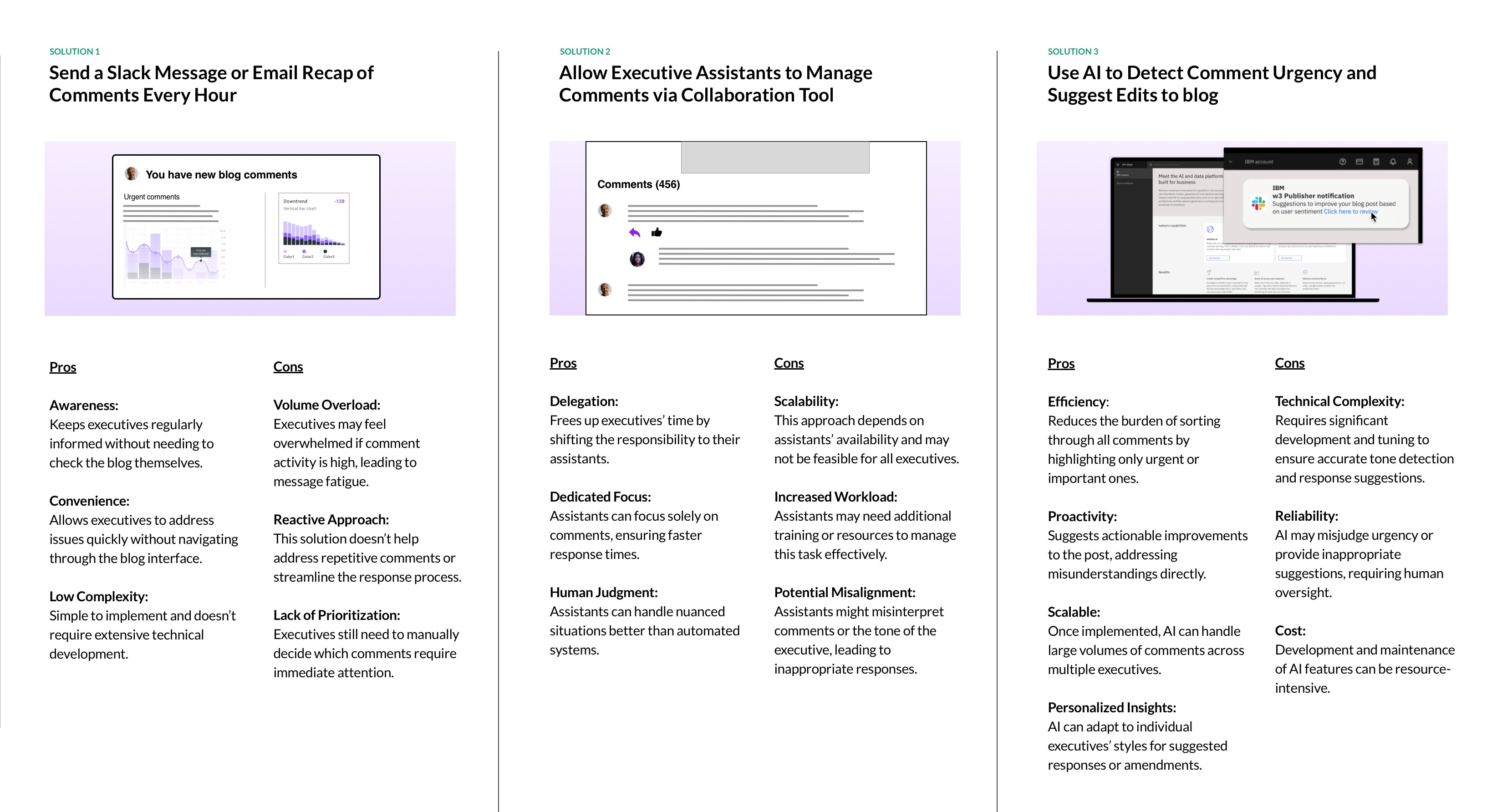
Prototype for Solution 3
Outcome
User Satisfaction
With our intuitive setup, you’re up and running in minutes.
Reduction in time to Publish
Adapt Area to your specific requirements and preferences.
Research & Design Value
User research and prototyping uncovered recurring executive pain points around feedback management — insights that continue to shape new AI-powered authoring tools under development.
Reflections
On Concept Validation
Even without a full build, the work proved that design prototypes can uncover unmet needs, generate executive interest, and shape product strategy early — a reminder that value isn't only in the ship.
On AI Integration
This project reinforced the importance of thoughtful AI integration — not just automating tasks, but augmenting user judgment in ways that build trust and confidence, especially among senior users.
On Designing for Leadership
On Designing for Leadership
Designing for executives revealed how time constraints, tone sensitivity, and high visibility make even “simple” tasks like replying to comments uniquely complex. Tailoring UX to match leadership workflows requires empathy, precision, and flexibility.
Thank you!
Next case study >
Get in touch
Connect with me to learn more.
Work
➔
About
➔
➔
@ Alicia Brooks
2025
All Rights Reserved
Work
About
IBM AI-Powered
Executive Tool
Case study
Introduction
At IBM, blogging is done through a platform called Publisher — the company’s global website builder used by over 500,000 IBMers to create and manage digital content, including blogs, product pages, and landing experiences. Publisher powers thousands of IBM sites and is a foundational tool within the company’s digital ecosystem.
While Publisher is robust, executive users faced unique challenges: their content often required faster turnarounds, strategic framing, and support from multiple stakeholders. Many executives struggled to draft or publish blogs efficiently, relying heavily on internal teams for writing, editing, and approvals. This led to missed opportunities to share timely thought leadership and created bottlenecks across communications workflows.
As the Lead Product Designer, I was tasked with reimagining how we support executive content creation. I led a team of four designers and partnered closely with product, engineering, and editorial stakeholders to shape a tool that integrated AI, simplified content workflows, and empowered executives to create high-impact narratives with less friction. I also presented designs and feature updates to large internal audiences, aligning teams around a shared vision for a smarter, faster way to communicate at scale.
Role
Lead designer, 4 person design team
Team
4 Designers, 7 Developers, 1 Product Owner, 1 Dev Lead
Timeline
1 month (2 sprints)
Tools
Figma, Mural, Jira, Storybook, IBM Carbon Design System
Skills used
Design Systems (Atomic Design)
Digital Transformation & Scalable Systems
Agile Methodologies & Design Ops
UX & UI Design
Information Architecture, Visual Design, Typography
Inclusive & Accessible Design
Agile Workflows, QA
The workflow
User Story
As an executive, I want to efficiently manage and respond to large volumes of comments, so that I can address repetitive inquiries without duplicating effort and minimize misunderstandings or negative engagement among employees.
Research findings
Pain points for Executives
- Comments flood in quickly at unpredictable times, making it challenging to address them in real time.
- Many comments are repetitive, requiring similar explanations multiple times.
- Executives attempt to respond to comments individually but struggle to manage the volume efficiently.
- The process is time-consuming, detracting from other priorities.
Pain Points for Employees:
- Unanswered questions amplify frustration
- Miscommunications go unaddressed, escalating to team-level confusion
- Trust deteriorates when leadership seems unresponsive
Proposed Solutions
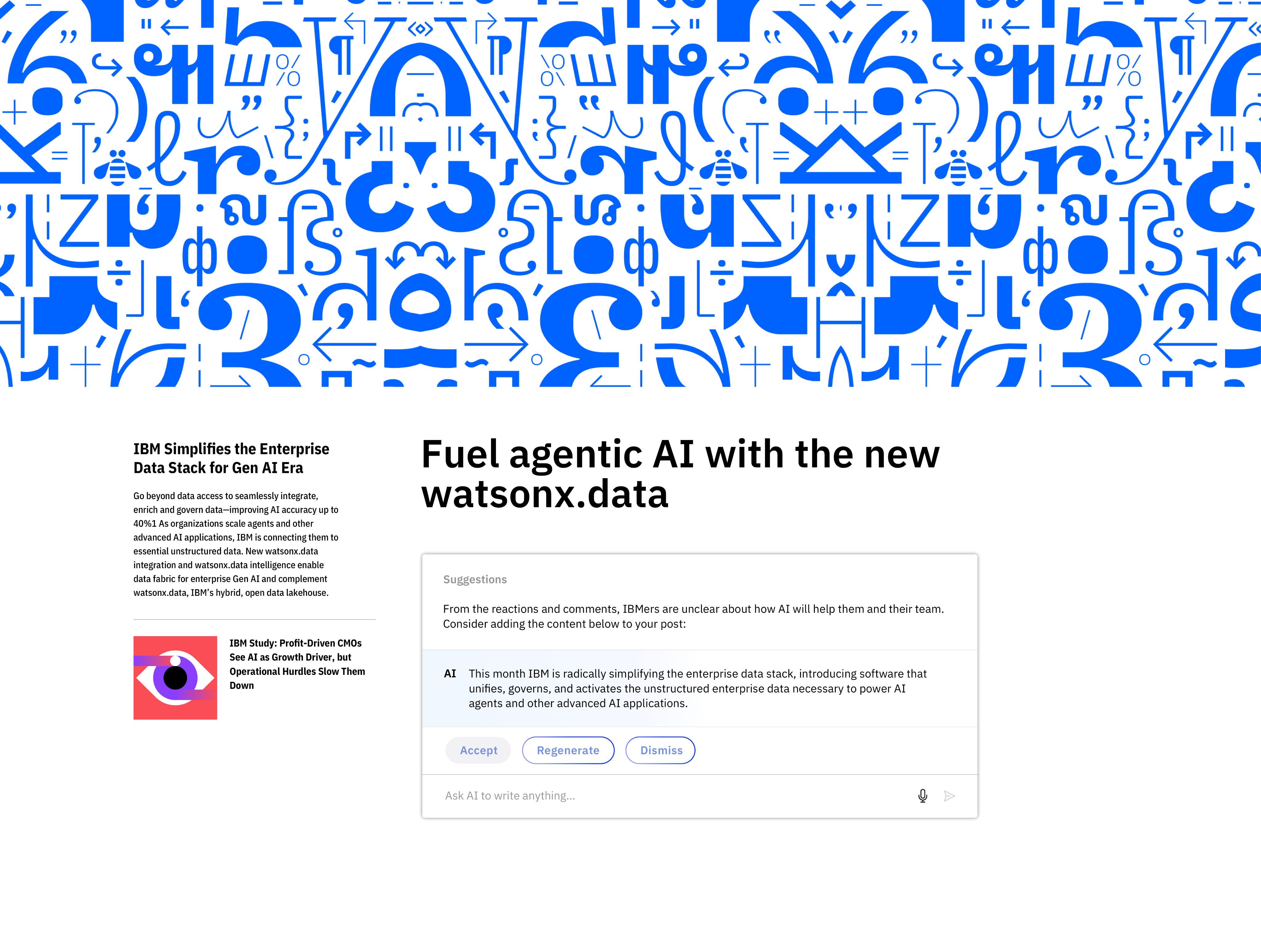
Prototype for Solution 3
Pros
✅ Efficiency – Highlights urgent/important comments to reduce sorting burden
✅ Proactivity – Suggests improvements to address misunderstandings directly
✅ Scalable – Can manage large volumes of comments once implemented
✅ Personalized Insights – Tailors suggestions to each executive’s communication style
Cons
❌ Technical Complexity – Requires significant dev work to detect tone and suggest responses accurately
❌ Reliability – May misjudge urgency or provide poor suggestions, needing human oversight
❌ Cost – AI development and maintenance can be resource-intensive
Outcome
We designed an AI-driven comment management experience that supports IBM executives by:
- Flagging high-priority comments based on urgency and sentiment
- Identifying repetitive themes, recommending bundled responses
- Suggesting post edits based on confusion or recurring feedback
- Learning individual executive communication styles to personalize tone and phrasing
While the feature has not yet been developed, the work served as a proof of concept and strategic design artifact. It helped clarify the potential for AI to streamline communication and reduce friction in leadership workflows — and remains a reference point for ongoing initiatives across IBM's digital publishing tools.
Reflections
User Satisfaction
The concept influenced long-term roadmap planning for AI features across IBM’s content platform, helping define a new category of executive-facing tools.
Stakeholder Buy-In
The design vision received strong cross-functional alignment from editorial, product, and design leadership, surfacing a clear opportunity for AI to reduce cognitive load and amplify executive communication.
Research & Design Value
User research and prototyping uncovered recurring executive pain points around feedback management — insights that continue to shape new AI-powered authoring tools under development.
On Concept Validation
Even without a full build, the work proved that design prototypes can uncover unmet needs, generate executive interest, and shape product strategy early — a reminder that value isn't only in the ship.
On AI Integration
This project reinforced the importance of thoughtful AI integration — not just automating tasks, but augmenting user judgment in ways that build trust and confidence, especially among senior users.
On Designing for Leadership
On Designing for Leadership
Designing for executives revealed how time constraints, tone sensitivity, and high visibility make even “simple” tasks like replying to comments uniquely complex. Tailoring UX to match leadership workflows requires empathy, precision, and flexibility.
Thank you!
Next case study >
Get in touch
Connect with me to learn more.
Work
➔
About
➔
➔
@ Alicia Brooks
2025
All Rights Reserved
Work
About
IBM AI-Powered
Executive Tool
Case study
Introduction
At IBM, blogging is done through a platform called Publisher — the company’s global website builder used by over 500,000 IBMers to create and manage digital content, including blogs, product pages, and landing experiences. Publisher powers thousands of IBM sites and is a foundational tool within the company’s digital ecosystem.
While Publisher is robust, executive users faced unique challenges: their content often required faster turnarounds, strategic framing, and support from multiple stakeholders. Many executives struggled to draft or publish blogs efficiently, relying heavily on internal teams for writing, editing, and approvals. This led to missed opportunities to share timely thought leadership and created bottlenecks across communications workflows.
As the Lead Product Designer, I was tasked with reimagining how we support executive content creation. I led a team of four designers and partnered closely with product, engineering, and editorial stakeholders to shape a tool that integrated AI, simplified content workflows, and empowered executives to create high-impact narratives with less friction. I also presented designs and feature updates to large internal audiences, aligning teams around a shared vision for a smarter, faster way to communicate at scale.
Role
Lead designer, 4 person design team
Team
4 Designers, 7 Developers, 1 Product Owner, 1 Dev Lead
Timeline
1 month (2 sprints)
Tools
Figma, Mural, Jira, Storybook, IBM Carbon Design System
Skills used
Design Systems (Atomic Design)
Digital Transformation & Scalable Systems
Agile Methodologies & Design Ops
UX & UI Design
Information Architecture, Visual Design, Typography
Inclusive & Accessible Design
Agile Workflows, QA
The workflow
User Story
As an executive, I want to efficiently manage and respond to large volumes of comments, so that I can address repetitive inquiries without duplicating effort and minimize misunderstandings or negative engagement among employees.
Research findings
Pain points for Executives
- Comments flood in quickly at unpredictable times, making it challenging to address them in real time.
- Many comments are repetitive, requiring similar explanations multiple times.
- Executives attempt to respond to comments individually but struggle to manage the volume efficiently.
- The process is time-consuming, detracting from other priorities.
Pain Points for Employees:
- Unanswered questions amplify frustration
- Miscommunications go unaddressed, escalating to team-level confusion
- Trust deteriorates when leadership seems unresponsive
Proposed Solutions
Prototype Created for Solution 3
Pros
✅ Efficiency – Highlights urgent/important comments to reduce sorting burden
✅ Proactivity – Suggests improvements to address misunderstandings directly
✅ Scalable – Can manage large volumes of comments once implemented
✅ Personalized Insights – Tailors suggestions to each executive’s communication style
Cons
❌ Technical Complexity – Requires significant dev work to detect tone and suggest responses accurately
❌ Reliability – May misjudge urgency or provide poor suggestions, needing human oversight
❌ Cost – AI development and maintenance can be resource-intensive
Outcome
We designed an AI-driven comment management experience that supports IBM executives by:
- Flagging high-priority comments based on urgency and sentiment
- Identifying repetitive themes, recommending bundled responses
- Suggesting post edits based on confusion or recurring feedback
- Learning individual executive communication styles to personalize tone and phrasing
While the feature has not yet been developed, the work served as a proof of concept and strategic design artifact. It helped clarify the potential for AI to streamline communication and reduce friction in leadership workflows — and remains a reference point for ongoing initiatives across IBM's digital publishing tools.
Reflections
Research & Design Value
The concept influenced long-term roadmap planning for AI features across IBM’s content platform, helping define a new category of executive-facing tools.
Stakeholder Buy-In
The design vision received strong cross-functional alignment from editorial, product, and design leadership, surfacing a clear opportunity for AI to reduce cognitive load and amplify executive communication.
Research & Design Value
User research and prototyping uncovered recurring executive pain points around feedback management — insights that continue to shape new AI-powered authoring tools under development.
On AI Integration
This project reinforced the importance of thoughtful AI integration — not just automating tasks, but augmenting user judgment in ways that build trust and confidence, especially among senior users.
On Designing for Leadership
Designing for executives revealed how time constraints, tone sensitivity, and high visibility make even “simple” tasks like replying to comments uniquely complex. Tailoring UX to match leadership workflows requires empathy, precision, and flexibility.
On Concept Validation
Even without a full build, the work proved that design prototypes can uncover unmet needs, generate executive interest, and shape product strategy early — a reminder that value isn't only in the ship.
Thank you!
Next case study >
Get in touch
Connect with me to learn more.
Work
➔
About
➔
➔
@ Alicia Brooks
2025
All Rights Reserved